Updating your news feed...

NEWS EXPRESS is Nigeria’s leading online newspaper. Published by Africa’s international award-winning journalist, Mr. Isaac Umunna, NEWS EXPRESS is Nigeria’s first truly professional online daily newspaper. It is published from Lagos, Nigeria’s economic and media hub, and has a provision for occasional special print editions. Thanks to our vast network of sources and dedicated team of professional journalists and contributors spread across Nigeria and overseas, NEWS EXPRESS has become synonymous with newsbreaks and exclusive stories from around the world.








.webp)

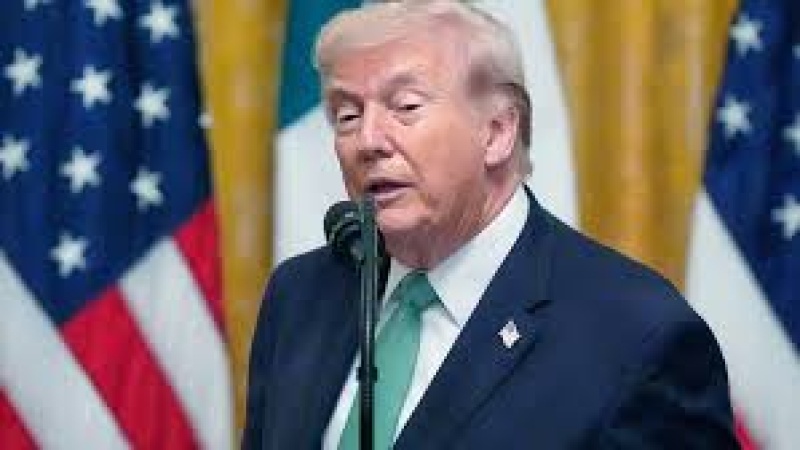
US President Donald Trump
By ABDULRAZAQ MAGAJI
By any measure, the idea of a “trump card” suggests a decisive, hidden advantage; something that can abruptly shift the balance in one’s favor. In his ongoing war with Iran, the question is whether such an advantage exists or, whether the very nature of the conflict, makes that idea illusory.
At first glance, Trump appears to hold several powerful cards. The United States remains the world’s preeminent military power, with unmatched air capabilities, global logistics, and advanced intelligence systems. In conventional terms, Iran cannot compete symmetrically. Washington can project force across continents, strike with precision, and sustain operations at a scale Tehran simply cannot match.
Yet wars are rarely decided by raw power alone. As analysts note, Iran’s strategy is not to defeat the U.S. outright, but to make victory prohibitively costly. This is where the notion of a Trump “trump card” becomes more complicated. Iran’s asymmetric capabilities, such as its network of regional proxies, missile systems, cyber tools, and its ability to disrupt global oil flows, serve as counterweights to U.S. superiority.
The closure of the Strait of Hormuz, through which a significant portion of the world’s oil passes, is perhaps Iran’s most potent leverage. Even the threat of such disruption has already rattled global markets and driven energy volatility. In this sense, Iran holds a kind of economic veto power over escalation. Any prolonged conflict risks triggering global recessionary pressures, in this regard, costs that would reverberate back into the American economy and domestic politics.
Trump’s potential “trump card,” therefore, may lie less in battlefield dominance and more in coercive diplomacy such as the ability to combine military pressure with negotiation. Recent indications that Washington has explored talks, even while mulling a ground invasion, suggest a dual-track strategy of escalation and de-escalation. In the event of its success, this approach could allow Trump to claim victory without full-scale war, by forcing concessions on Iran’s nuclear programme while avoiding a prolonged conflict.
However, this strategy carries inherent contradictions. Coercive diplomacy depends heavily on credibility and trust, both of which may be in short supply. Iran has historically viewed U.S. intentions with deep suspicion, and mixed signals from Washington, which oscillates between threats of regime change and denials of such goals, complicate negotiations. Ultimately, if Tehran believes that concessions will not guarantee security, it has little incentive to yield.
Moreover, Trump’s domestic political base introduces another level of uncertainty. Reports indicate a growing divide among his supporters, with some opposing deeper military engagement. For Trump, therefore, a prolonged or costly war could erode political capital at home and limit the administration’s room for maneuvering. In that sense, time may not be on Trump’s ideas it has the potential to turn a seeming strategic advantage into a liability.
Another possible “trump card” is unpredictability itself. Trump has long cultivated a reputation for erratic decision-making, which some argue is aimed at keeping adversaries off balance. In theory, uncertainty can function as a deterrent; in other words, if Iran cannot predict U.S. actions, it may act more cautiously. But then, unpredictability cuts both ways. It can easily lead to miscalculation, escalation, or the loss of allied confidence, especially if American partners and allies feel excluded or coerced rather than consulted.
Indeed, one notable weakness in the current scenario is the relative lack of a broad international coalition. Unlike previous large-scale U.S. interventions, where alliances provided legitimacy, this present U.S conflict with Iran appears more unilateral. That isolation could limit diplomatic leverage and increase the costs borne solely by the United States.
Ultimately, the idea of a single decisive “trump card” may be misplaced.
If Trump has a real advantage, it lies in his ability to define the terms of victory. This is a narrowly framed objective, such as degrading specific capabilities or securing limited concessions, that could allow him to declare victory and exit. But if the goals expand toward regime change or total capitulation, the U.S. risks becoming entangled in a protracted and unpredictable conflict with no clear endpoint.
Essentially, the ultimate “trump card” may not be military or economic, rather, it may be restraint, such as the ability to recognize the limits of power and to convert pressure into a sustainable political outcome.
Whether Trump will play that card remains the defining question of his war with Iran.
•Magaji Magaji778@gmail.com writes from Abuja.