Updating your news feed...

NEWS EXPRESS is Nigeria’s leading online newspaper. Published by Africa’s international award-winning journalist, Mr. Isaac Umunna, NEWS EXPRESS is Nigeria’s first truly professional online daily newspaper. It is published from Lagos, Nigeria’s economic and media hub, and has a provision for occasional special print editions. Thanks to our vast network of sources and dedicated team of professional journalists and contributors spread across Nigeria and overseas, NEWS EXPRESS has become synonymous with newsbreaks and exclusive stories from around the world.


























Loading banners
Loading banners...

Food items
A mix of Ramadan demand and logistics costs has activated a sharp spike in Nigerian food prices, ending a short-lived era of single-digit inflation.
Market surveys conducted by BusinessDay around Lagos revealed that prices of certain staples used for jollof rice and stew – two common dishes in households during Ramadan celebration – have risen above their prices in January of 2026.
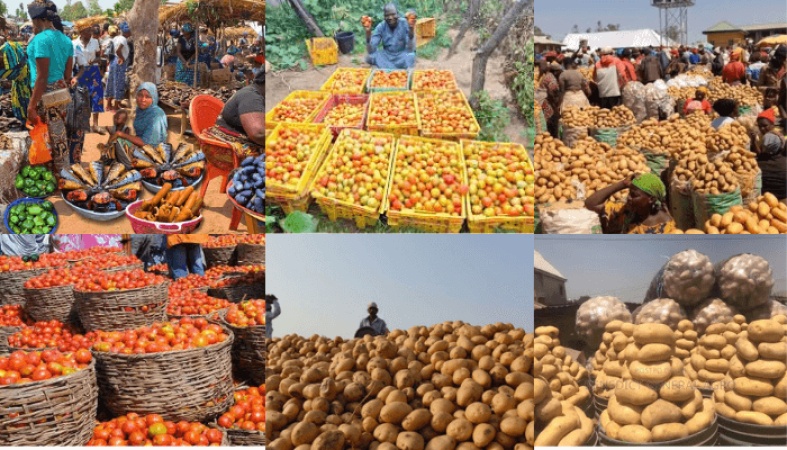
A 50kg bag of rice currently sells for around N61,000, up from an average of N56,000 in January. The price, however, depends on brand and grain size. While a big basket of fresh tomatoes currently sells for an average of N41,000, up 17 percent from its value in January (N35,000).
For fresh pepper, the same rising trend is noted during the survey. A bag of fresh pepper now sells for roughly N46,000 against around N30,000 in January.
“Tomato prices are a bit high now because many farmers are not farming due to the fast, but after the fast, they will return to the farm, and prices will stabilise,” a Lagos tomato trader said.
Although prices of rice and tomatoes have increased, prices of other key jollof rice ingredients like vegetable oil and palm oil have dropped during the period.
A 25 litres keg of vegetable oil is sold for roughly N55,000, down from around N66,000 in January, while palm oil prices have dropped to N48,000 from about N58,000.
Bose Idowu, a trader at Ketu Market, told BusinessDay that: “Prices of some items are surging while some have remained relatively stable.”
However, Idowu noted that the prices of essential staples are expected to surge further owing to a hike in fuel prices that would invariably affect the costs of transporting food commodities from the northern region, where they are most grown, to markets in the south.
“Transporters have started increasing their cost of carrying goods for us because of the fuel price increase. We are going to transfer that extra cost to the consumers,” she said.
The pressure from Ramadan spiked food inflation to 12.12 percent in February, a month after it hit 8.89 percent in January – its first single digit in over a decade. It also spearheaded a reversal in month-on-month food inflation after months of consistent deflationary trend, according to the National Bureau of Statistics (NBS).
“This sudden uptick in the food basket was largely driven by the Ramadan effect. With the holy month commencing on February 18, 2026, Nigerian households pivoted from post-harvest caution to aggressive bulk-buying and stockpiling.” AIICO Capital said in its inflation report.
As the United States and Iran war rages without talks of a ceasefire, global oil prices have more than tumbled in less than a month since the war began.
Petroleum marketers and retailers have reviewed their prices alongside Dangote Refinery’s decision to raise its prices too. With logistics costs and retailer margins stacked on top, consumers across Lagos, Abuja, and Port Harcourt are already reporting pump prices edging toward N1200 per litre.
In Nigeria, whenever petrol prices surge, food prices invariably rise due to the high costs incurred in transporting commodities from farms to different markets across the country.
Muhammed Magaji, president of the All Farmers Association of Nigeria (AFAN), said the costs of transporting commodities from farms to markets are likely to increase.
“Food prices are going to surge because of a rise in logistics costs. It costs more now to transport commodities from farms to markets,” Magaji told BusinessDay, noting that the average cost of production could double compared to 2025, pushing more farmers into poverty and discouragement. (BusinessDay)