Updating your news feed...

NEWS EXPRESS is Nigeria’s leading online newspaper. Published by Africa’s international award-winning journalist, Mr. Isaac Umunna, NEWS EXPRESS is Nigeria’s first truly professional online daily newspaper. It is published from Lagos, Nigeria’s economic and media hub, and has a provision for occasional special print editions. Thanks to our vast network of sources and dedicated team of professional journalists and contributors spread across Nigeria and overseas, NEWS EXPRESS has become synonymous with newsbreaks and exclusive stories from around the world.























Loading banners
Loading banners...

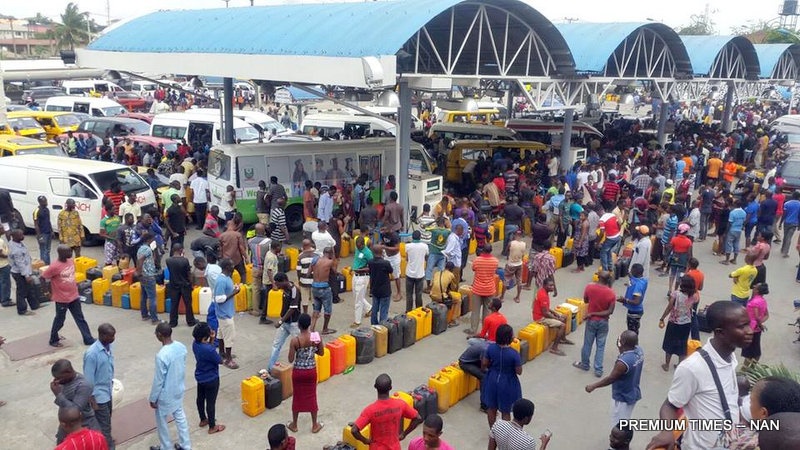
queue at a petrol station
Economists and development experts have warned that the recent surge in global crude oil prices, which is driven by escalating tensions in the Middle East, will continue to push up transport fares, food prices and the overall cost of living in Nigeria in the coming months.
They noted that disruptions in global oil supply could worsen inflationary pressures in the country, particularly as the country remains heavily dependent on imported refined petroleum products.
Professor of Economics and Public Policy at the University of Uyo, Akpan Ekpo, said the rising global oil prices, linked to the on-going conflict involving Israel, the United States and Iran, could lead to higher fuel prices locally, which would ultimately translate to higher inflation.
According to him, once fuel prices increase, transport costs, airfares and prices of goods and services are also likely to rise.
“The spike in oil prices globally will result in rising inflation and affect the cost of living. When the price of fuel goes up, transport prices will increase and virtually all sectors of the economy will be affected because the economy is largely driven by petroleum resources,” he said.
Ekpo explained that the impact could be felt both in the short and medium term if the crisis persists, noting that prolonged supply disruptions in the global oil market could worsen the situation.
He added that rising transport costs could also push food prices higher since farm produce must be moved from rural areas to urban markets.
“To cushion the extraordinary increase in food prices in the short term, the government may need to import food. In the long term, however, Nigeria must take agricultural production more seriously and address security challenges so that farmers can return to their farms and increase food output,” he said.
Also speaking, Group Managing Director and Chief Executive Officer of Bristol Investments Limited, Dr Chijioke Ekechukwu, said the extent to which inflation may rise would depend largely on how long the conflict lasts. He said government still has a role to play in preventing further price shocks within the domestic economy.
According to him, Nigeria, as an oil-producing country, can stabilise petroleum product prices locally by ensuring that crude supplied to domestic refineries is sold at controlled rates rather than prevailing international market prices.
“If this is done, petroleum product prices can remain relatively stable in Nigeria,” he said.
Ekechukwu also urged the authorities to strengthen border security to prevent the smuggling of petroleum products to neighbouring countries.
Similarly, economic and development expert, Dr Aliyu Ilias, warned that disruptions in the global oil supply chain, particularly around the Strait of Hormuz, could further drive up crude oil prices and fuel inflationary pressures in Nigeria.
He noted that although higher oil prices could increase government revenue since Nigeria’s 2026 budget benchmark was set at $64.8 per barrel, ordinary citizens may face more economic hardship due to rising fuel and transportation costs.
“When the price of crude oil increases, it should ordinarily benefit Nigeria because we produce oil. But the reality is that while government earns more revenue, citizens pay more because we still rely heavily on imported refined products,” he said.
Ilias also pointed out that petrol prices have already begun to rise in some areas, with some filling stations selling for as high as N1,300 per litre. He warned that higher fuel prices would inevitably translate into increased transportation costs, which would then push up the prices of goods and services across the country.
“Anything that affects transportation will affect goods and services, especially food items that have to be transported from farms to markets. That will ultimately drive inflation,” he said.
He further cautioned that the development could erode some of the macroeconomic gains recently recorded in the country if urgent steps are not taken to address the situation. The expert therefore urged the government to accelerate efforts to boost local refining capacity, build strategic fuel reserves and strengthen regulatory oversight in the petroleum sector to cushion Nigerians from the impact of global oil market shocks.
Fuel prices and cost of doing business
Nigerian manufacturers and small business owners are worried that higher fuel prices are resulting in high costs of doing business. With fuel playing a central role in transportation, production, and power generation, stakeholders say Nigerian businesses, particularly small and medium-scale enterprises (SMEs), are already feeling the pressure from rising global oil prices triggered by the geopolitical crisis in the Middle East.
Chairman of the Lagos chapter of the National Association of Small Scale Industries (NASSI), Gertrude Akhimien, explained that the ripple effects of higher fuel prices will spread across the entire supply chain.
According to her, the transportation of goods, including raw materials and finished products, will become more expensive, while the cost of staff commuting to and from work will also rise.
“The overheads for warehousing, distribution, and logistics services will go up. There will also be pressure on profitability, especially for low-margin or commodity-driven sectors,” she said, warning that as operational costs increase, businesses will have little choice but to pass the additional costs to consumers.
Akhimien noted: “This will ultimately result in higher prices of goods in the market because businesses must transfer the increased cost of production and logistics to the final consumer.”
She therefore called for urgent government intervention to cushion the impact on SMEs and critical sectors of the economy.
According to her, temporary relief measures such as targeted subsidies for essential sectors, tax reductions for critical services, and financial support for struggling small businesses would help them remain afloat during the crisis. She suggested that government could temporarily reduce or exempt certain taxes on essential goods and the transport sector to reduce the cost of moving goods and services. In addition, she advocated subsidies or grants for micro, small, and medium enterprises to help them survive until global energy markets stabilise.
How Nigeria can shield economy from global oil price shock
Providing another perspective, David Etim, Project Lead, Calabar and Gulf of Guinea Municipal and Trade Centre, argued that Nigeria could shield its economy from global oil price shocks by strengthening domestic refining.
He noted that with the operational capacity of the Dangote Refinery, the government could allocate a portion of Nigeria’s crude oil production for domestic refining at controlled prices.
Etim explained that instead of selling all crude oil at international market prices, the government could supply crude locally at a moderate price to stabilise fuel costs within the country.
“If the actual production cost of crude oil is about $35 per barrel, the government could supply it domestically at around $50 per barrel, including margin,” he suggested. Such a policy, he explained, would enable local refineries to produce fuel at lower costs than international market rates, thereby helping stabilize fuel prices for businesses and consumers.
He further suggested that the government could dedicate about 450,000 barrels of crude oil per day for domestic refining while exporting the remaining output to meet national revenue targets.
According to him, this approach would ensure stable local fuel prices, reduce Nigeria’s exposure to global price volatility, and guarantee reliable fuel supply for businesses. Etim also pointed out that fuel smuggling across borders worsens shortages and drives up local prices.
He recommended that agencies such as the Nigeria Customs Service deploy digital tracking and geo-fencing technology to monitor fuel trucks leaving refineries. With such technology, trucks attempting to divert fuel across borders illegally could be detected and stopped, helping to maintain supply within the country. He added that Nigeria could still meet its budgetary obligations by exporting the remaining crude oil within its quota under the Organisation of the Petroleum Exporting Countries, while reserving a portion for domestic consumption. In addition, temporary financial measures such as borrowing or other inflows could serve as buffers while production levels improve.
Oil prices and deepening economic hardship
Meanwhile, Imokhai Ehimigbai, a member of the Manufacturers Association of Nigeria Export Group, warned that rising fuel prices would deepen economic hardship for both businesses and consumers. “When fuel prices increase, transport fares rise, food prices increase, and ordinary Nigerians face more hardship,” he said. He noted that manufacturers and SMEs are deeply involved in logistics, production, and distribution, meaning they cannot escape the effects of higher energy costs.
“At the end of the day, the final consumer bears the cost,” he added.
Ehimigbai also questioned why Nigeria, despite being one of the world’s major oil producers, still struggles to supply crude oil to domestic refineries.
He expressed concern that if the Middle East conflict escalates further, Nigerians may face even greater economic hardship due to rising energy prices.
For stakeholders, the message is clear: while global geopolitical tensions may be beyond Nigeria’s control, strategic domestic policies, particularly in refining, supply management, and SME support, could help shield businesses and consumers from the worst effects of global fuel price shocks.
Why petrol prices rise in Nigeria
The removal of the long-standing fuel subsidy in May 2023, by President Bola Tinubu set the stage for rising petrol prices in Nigeria. Before then, the government paid part of the petrol cost. Following subsidy removal, petrol prices are now determined by market forces such as crude oil price, exchange rate, and supply costs. This single policy change caused the largest jump in petrol prices in decades.
A weak naira and dollar dependence is also another factor. Nigeria still pays for many petroleum transactions in U.S. dollars. When the naira weakens, importers need more naira to buy fuel. This increases the landing cost of petrol, which marketers pass on to consumers. Although, with the coming on stream of the Dangote Refinery, the level of fuel imports have reduced drastically.
Petrol prices depend heavily on the cost of crude oil. When global crude prices rise, refining and import costs also increase as currently being witnessed with the geopolitical tensions in the Middle East, which have pushed oil prices up globally. Moving petrol across Nigeria is expensive because of poor road infrastructure, high transportation costs, and security issues in some regions. All these costs are added to the final pump price. Nigeria’s limited domestic refining capacity is another major setback why petrol prices remain high. Nigeria is a major crude oil producer but historically imports most of its refined fuel.
Importing petrol involves shipping, insurance, and port charges. These additional costs push up prices. The Dangote Refinery is expected to reduce imports, but prices will still reflect global oil prices and exchange rates. Market competition and depot pricing also drive up prices. Petrol retailers buy fuel from depots or refineries. When depot prices increase, filling stations adjust their pump prices. Competition among marketers also affects pricing. (The Sun)