Updating your news feed...

NEWS EXPRESS is Nigeria’s leading online newspaper. Published by Africa’s international award-winning journalist, Mr. Isaac Umunna, NEWS EXPRESS is Nigeria’s first truly professional online daily newspaper. It is published from Lagos, Nigeria’s economic and media hub, and has a provision for occasional special print editions. Thanks to our vast network of sources and dedicated team of professional journalists and contributors spread across Nigeria and overseas, NEWS EXPRESS has become synonymous with newsbreaks and exclusive stories from around the world.






















Loading banners
Loading banners...

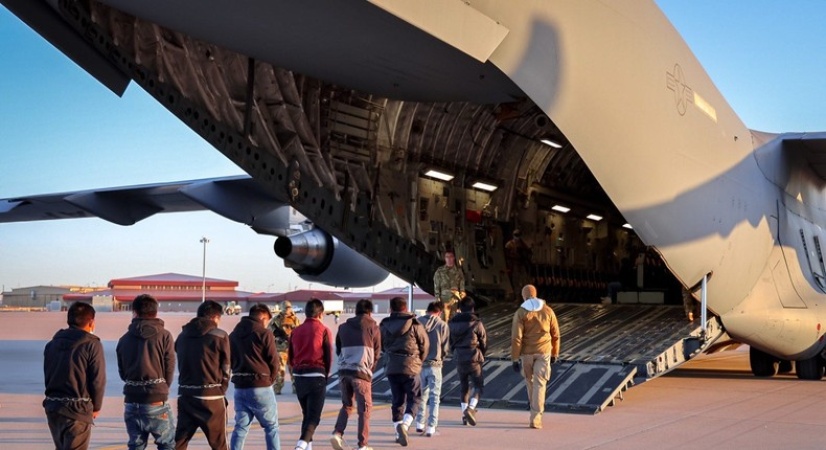
The United States has expanded the use of third-country deportations to several African countries, a policy shift that is drawing scrutiny over its financial cost and oversight mechanisms, according to a report by Democrats on the Senate Foreign Relations Committee.
The findings, first reported by Semafor, estimate that the programme has cost U.S. taxpayers more than $40 million through January 2026.
Under the approach, migrants are transferred to countries that are not their countries of origin.
The report describes the system as one in which Washington “urges or coerces countries to accept migrants who are not their citizens,” often through financial arrangements.
What was once described as a rare diplomatic tool has, according to the report, “become a routine instrument of diplomacy.”
Several African countries have become part of the framework. According to the report, Equatorial Guinea, Eswatini and Rwanda received direct payments to accept deportees.
Ghana has taken in West African nationals under similar arrangements, while South Sudan and Uganda have also been involved in third-country transfers.
While the agreements and their terms have not been publicly detailed; the report states that “through a growing web of bilateral arrangements, the United States is convincing foreign governments to take in people with no connection to their country, largely through financial payments or pressure.”
As of January 2026, Rwanda had received seven migrants under the arrangement, Eswatini 15, and Equatorial Guinea 29.
The committee report estimates that more than $32 million was paid directly to five countries: Equatorial Guinea ($7.5 million), Rwanda ($7.5 million), Eswatini ($5.1 million), El Salvador ($4.76 million) and Palau ($7.5 million).
Much of the funding was provided as lump-sum payments. In addition, military aircraft were used for the transfers, with operating costs said to exceed $32,000 per hour.
Flights carrying 51 individuals to Rwanda, Eswatini and Equatorial Guinea over seven months cost an estimated $2.5 million.
The report also raises questions about monitoring and compliance. It says the State Department “is not tracking foreign government compliance with diplomatic assurances or enforcing agreement terms, even where evidence suggests foreign governments are violating their commitments.”
In some cases, the report states that migrants could have been returned directly to their home countries, avoiding additional flights and expenses.
It further describes the programme as “little more than an expensive deterrent with no measurable benefit.”
The administration, however, has defended third-country deportations as necessary where home countries refuse to accept their nationals, maintaining that the arrangements expand enforcement options and diplomatic leverage.
The migration arrangements come amid broader engagement between African governments and the United States across security, humanitarian and diplomatic areas.
The policy has drawn mixed reactions from analysts. Some view participation as raising questions about Africa’s negotiating leverage, while others describe it as a pragmatic decision shaped by national interests and economic considerations.
More broadly, for many governments, such cooperation forms part of established bilateral relationships rather than alignment with U.S. domestic political debates.
In parallel, South Sudan’s fiscal and humanitarian pressures have continued to draw attention from Washington, with the United States mobilising billions of dollars in assistance in recent months to address food insecurity and displacement.
Similarly, Ghana has remained engaged in discussions with U.S. authorities on migration and visa policy matters following recent adjustments affecting certain categories of travellers.
Rwanda has featured prominently in diplomatic efforts, including mediation linked to tensions involving the Democratic Republic of Congo.
Eswatini, which maintains longstanding diplomatic ties with Washington, has also continued cooperation with the United States on security and migration matters.
At the same time, some governments have reportedly declined participation in third-country deportation arrangements, while others have entered into agreements based on strategic, financial or diplomatic considerations.
With total programme costs estimated at more than $40 million, according to the Senate committee report, attention is likely to remain focused on the scope, structure and long-term impact of the third-country deportation arrangements. (Business Insider Africa)