Updating your news feed...

NEWS EXPRESS is Nigeria’s leading online newspaper. Published by Africa’s international award-winning journalist, Mr. Isaac Umunna, NEWS EXPRESS is Nigeria’s first truly professional online daily newspaper. It is published from Lagos, Nigeria’s economic and media hub, and has a provision for occasional special print editions. Thanks to our vast network of sources and dedicated team of professional journalists and contributors spread across Nigeria and overseas, NEWS EXPRESS has become synonymous with newsbreaks and exclusive stories from around the world.













Loading banners
Loading banners...

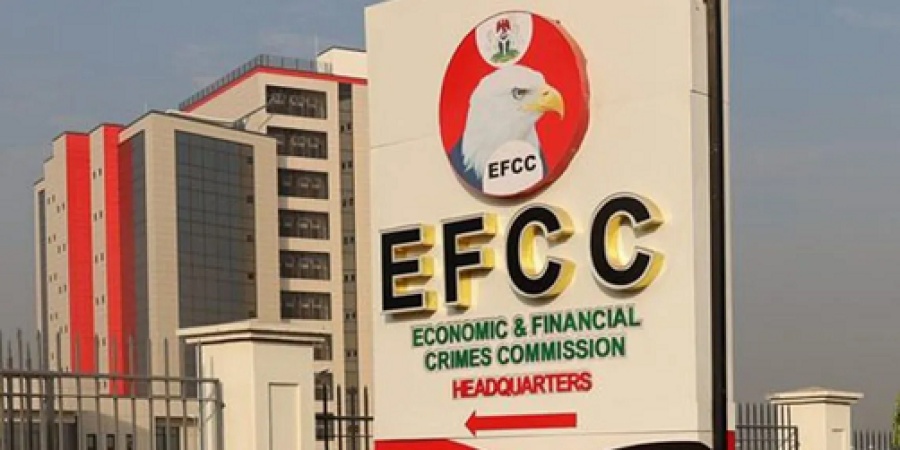
EFCC National Headquarters
The Economic and Financial Crimes Commission (EFCC) has proposed to spend N3.2 billion on fuel, cleaning and fumigation services as well as meals and refreshments in the 2026 fiscal year.
The expenditure is captured under the presidency section of the 2026 budget presented by President Bola Ahmed Tinubu to a joint session of the National Assembly on December 19.
A budget document obtained from the Budget Office of the Federation shows that the anti graft agency earmarked N278.6 million for cleaning and fumigation services, while N722 million was allocated for refreshment and meals.
In addition, the EFCC budgeted N1.02 billion for motor vehicle fuel costs and N1.2 billion for the fuelling of generators, bringing its total projected spending on cleaning, food and energy related services to over N3.2 billion in the 2026 fiscal year.
The document further revealed that the commission plans to spend N170.5 million on drugs and medical supplies, N376.5 million on vehicle and transport equipment maintenance and N46 million on the maintenance of office furniture.
Also captured in the budget is a proposed N1.5 billion for the maintenance of office buildings and residential quarters, as well as N159.8 million for the maintenance of office and IT equipment.
The 2026 appropriation bill has a total expenditure estimate of N58.18 trillion, including N15.52 trillion for debt servicing, with projected revenue of N34.33 trillion, leaving a deficit of N23.85 trillion to be financed through domestic and foreign borrowing.
The EFCC is one of several agencies whose recurrent spending provisions have drawn attention in the ongoing review of the 2026 budget by the National Assembly.
Reacting to the figures, public affairs analysts have continued to express concerns over what they describe as repetitive and excessive recurrent expenditure across government agencies.
They warned that such spending patterns create room for waste and weaken the impact of the national budget on the lives of ordinary Nigerians.
According to the Executive Director of the Centre for Anti Corruption and Open Leadership (CACOL), Comrade Debo Adeniran, the development represents the culture of waste in public sector budgeting.
“We have always been complaining that the system we are operating is bad because of its penchant for profligacy. That is why the same items on the budget keep repeating themselves. They have to renovate houses and offices every year and buy a new set of furniture. MDAs repeat the same budget line year in, year out,” Adeniran said.
He warned that such recurrent spending could serve as a conduit for diversion of public funds, adding that “government officials find every means to create avenues within the budget to take care of their own comfort and convenience.”
For his part, a political scientist, Dr. Kabiru Sa’id Sufi, said overhead costs were increasingly taking a large portion of government expenditure.
“The assessment people are making about the budget is that overhead is increasingly taking a large chunk of the money, which shouldn’t be. We need to cut down on unnecessary expenditure. The budget sometimes appears to be a recycled document with few adjustments,” he said.
Dr. Sufi added that the repeated appearance of the same items in annual budgets suggests that many of the expenditures are either unnecessary or not being properly implemented.
“If you look at MDAs, you will keep seeing the same thing being repeated almost annually in their budgets, with only differences in figures. It means that most of those things budgeted are not really needed,” he said.
(Daily Trust)