
Updating your news feed...
NEWS EXPRESS is Nigeria’s leading online newspaper. Published by Africa’s international award-winning journalist, Mr. Isaac Umunna, NEWS EXPRESS is Nigeria’s first truly professional online daily newspaper. It is published from Lagos, Nigeria’s economic and media hub, and has a provision for occasional special print editions. Thanks to our vast network of sources and dedicated team of professional journalists and contributors spread across Nigeria and overseas, NEWS EXPRESS has become synonymous with newsbreaks and exclusive stories from around the world.






















Loading banners
Loading banners...

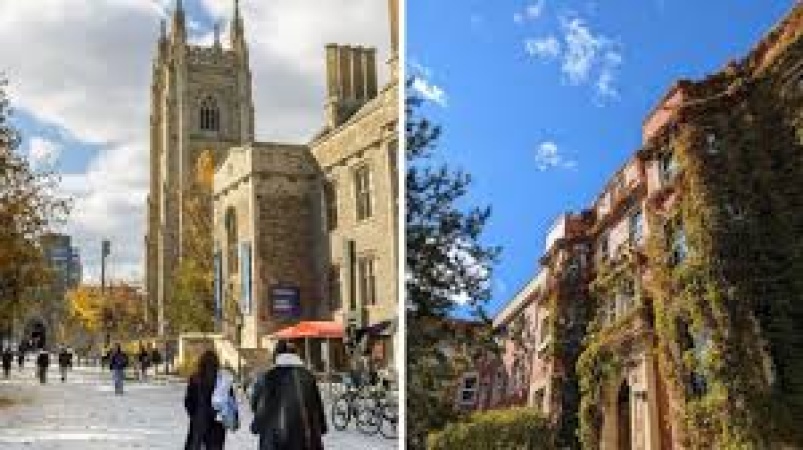
Some Canadian universities have free online courses that you can take now.
You don't have to be a current student or have any post-secondary education to enrol.
If you want to learn something new or further knowledge you already have, the University of Toronto, University of British Columbia, University of Alberta and Université de Montréal offer free courses.
These classes are available through online education platforms EdX and Coursera.
You can enrol in the courses for free, which is sometimes referred to as an "audit" or a "free trial."
That means you'll be able to learn from the provided course materials at your own pace.
If you want assignments graded by professors and a certificate at the end of the session, you have to pay a fee.
Since there are no prerequisites required, you can take these courses even if you have never taken a university or college class before.
For many classes, you don't need any prior experience with the subject either.
Also, you don't have to be a current student at these Canadian universities to enroll in these free courses.
So, here are 12 free online courses from the University of Toronto, University of British Columbia, University of Alberta and Université de Montréal that you can take right now.
This free University of Toronto course explores what cities do, why they matter, what shapes urbanization and how to choose the right city for you.
You'll learn about the importance of cities and how cities affect our lives.
At the end of the course, you'll complete an exercise to assess your own community and find the best place for you.
In this University of British Columbia course, you'll learn about Excel fundamentals and develop essential Excel skills.
Topics include simple data wrangling, managing spreadsheets, effective data visualization, and the foundations of business data analysis.
In this course from the Université de Montréal, you'll learn about the role, challenges and potential of sustainable food systems to ensure food security, human health and planetary health.
These food systems are examined through the context of climate crises, chronic disease epidemics and geopolitical crises.
There are lessons on the nuances between food security and food sovereignty, solutions for more sustainable food systems, and more.
The course from the University of Alberta explores histories and contemporary perspectives of Indigenous peoples living in Canada.
It'll teach you about the complex experiences of Indigenous peoples, highlighting national and local Indigenous-settler relations.
Lesson topics include the fur trade and exchange relationships, land claims, environmental impacts, political conflicts and alliances, Indigenous political activism, and contemporary Indigenous life and art.
In this course from the University of Alberta, you'll learn the concepts behind black holes along with the basic ideas of astronomy, relativity and quantum physics.
After these lessons, you'll be able to compare black holes in popular culture to modern physics, recognize different types of stars, distinguish which stars could become black holes and more.
With this University of Toronto course, you'll learn about the brain, human development, mental illnesses and treatments, and psychological studies.
Lessons will cover experiments in the field of psychology, cognitive abilities like memory, learning, attention, perception and consciousness, and how the behaviour of others affects our thoughts and behaviour.
This University of British Columbia course focuses on learning a systematic programming method rather than a programming language.
That's meant to help you be able to program in any programming language.
You'll learn techniques to develop program requirements, produce programs with consistent structure, and make programs more reliable.
In this University of Alberta course, you'll get an overview of non-avian dinosaurs.
There is a focus on the anatomy, eating habits, locomotion, growth, environmental and behavioural adaptations, origins and extinction of dinosaurs.
Even though the class is online, lessons are delivered from museums, fossil-preparation labs and dig sites.
This course from the University of British Columbia teaches the core concepts and tools of marketing to help you better understand and excel in the field.
Topics include market research and its importance, brand strategy, pricing, integrated marketing communication, social media strategy, and more.
This University of Alberta course explores the major histories, migrations, artists, and activists that contributed to the survival of Black people in Canada.
Also, you'll learn about how Canadian views of multiculturalism have influenced Black communities across the country.
Managing Your Health: The Role of Physical Therapy and Exercise
this course offered by the University of Toronto, you'll learn about the concepts and benefits of physical therapy and exercise.
Topics of the lessons include the importance of physical activity, common sports injuries, and how exercise relates to cardiovascular disease, osteoporosis, cancer and arthritis.
course from Université de Montréal explores how computer algorithms can be biased and impact everyday lives.
The main focus areas of the class are gender, race and socioeconomic bias, along with bias in data-driven predictive models.
You'll learn how to identify and alleviate bias and discrimination in AI.
Enrol Here (NARCITY Media, but headline rejigged)
• Photo combo of University of Toronto, University of British Columbia, University of Alberta and Université de Montréal



