
Updating your news feed...
NEWS EXPRESS is Nigeria’s leading online newspaper. Published by Africa’s international award-winning journalist, Mr. Isaac Umunna, NEWS EXPRESS is Nigeria’s first truly professional online daily newspaper. It is published from Lagos, Nigeria’s economic and media hub, and has a provision for occasional special print editions. Thanks to our vast network of sources and dedicated team of professional journalists and contributors spread across Nigeria and overseas, NEWS EXPRESS has become synonymous with newsbreaks and exclusive stories from around the world.













Loading banners
Loading banners...

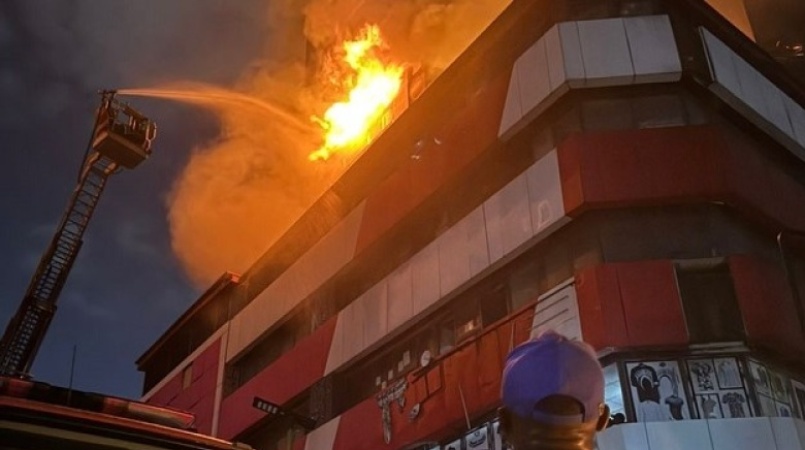
The torched Great Nigeria Insurance GNI House
Death toll from the fire that gutted Balogun commercial district on Lagos Island stood at five as at 6 pm on Sunday, five days after a fire that started from a single room apartment turned into one of the deadliest market disasters in Lagos, Nigeria’s commercial nerve centre.
Two more bodies, both men, were pulled out from the rubble earlier in the day, about 2:23 pm, marking ‘Day Five’ of a rescue mission said to have been slowed down by the raging fire, which started about 4 pm on December 24.
The recovered bodies were at different stages of decomposition and could not be recognised. When The Nation visited the place, eyewitnesses and market leaders said about 100 people may still be trapped beneath the debris of the five collapsed buildings, including areas under the still-standing Great Nigeria Insurance (GNI) House.
The GNI House, which was still smouldering, has underground sections and upper floors believed to house trapped traders. According to them, the intense heat emitting from the fire forced rescue teams to halt excavation.
Beyond the loss of lives, the economic devastation is staggering, with traders estimating that goods worth hundreds of billions of naira — including textiles, fashion materials, finished garments and imported stock —destroyed in the blaze.
Entire warehouses, some holding thousands of containers’ worth of goods, were wiped out. “This building alone carries over 3,000 container loads of goods,” a trader said, lamenting that “millions of people depend on this market daily. Now, we are jobless.”
Some of the traders also lamented that insurance coverage has been limited, noting that insurance companies had long refused to underwrite many of the shops due to safety concerns, leaving most victims exposed.
Emergency responders confirmed that the persistent blaze is their biggest obstacle. “The ground is still hot. Bulldozers cannot dig where fire is burning,” Plant Manager of Equipment Hub at Lagos State Emergency Management Agency (LASEMA), Salami Jamiu, who was on site, said. “We have to be alive to save others. We are proceeding cautiously,” Jamiu noted. He said while multiple agencies, including LASEMA, NEMA, Lagos Fire Service, Red Cross, and even private firms like Julius Berger, United Bank of Nigeria (UBA) and Nigeria Port Authority (NPA) provided tankers and support, the intensity of the fire made rescue efforts dangerous.
Market leaders speak
Market leaders insist the tragedy could have been contained. For instance, Chair of Association of Fashion Wears Dealers in the state, Clement Molokwu, said the fire started modestly. “It started from one room on the fourth floor. There was nothing so serious initially,” he said. “The fire gave enough time, but unfortunately it was allowed to escalate.”
Traders said two fire trucks arrived early, but couldn’t reach the source of the fire. “The first truck could not do anything,” an eyewitness said, noting: “It was only later they came with a bigger truck with a crane. By then, it was too late.”
Multiple sources also blamed the disaster on unchecked commercialisation of residential and parking spaces, allegedly enabled by lax enforcement and collusion.
“The three floors of the car park in the GNI Building were converted to shops,” said one trader. According to the trader, who declined to have his name in print, “that car park collapsed on nearby buildings, killing people.”
Five buildings collapsed; three on Fred Martins Street and others in Shitta-Bey Court, trapping traders under concrete, goods, and twisted iron.
“Every tiny space here has been turned into a shop,” another trader said, adding “families that own these buildings, with some local government officials, collect money and allow people to trade anywhere.”
However, one of the survivors, who identified himself simply as Ogechukwu, said he escaped death by whiskers
“When I saw the fire, I went in to salvage my goods. I was almost out when I heard an explosion. I escaped by the whiskers,” he said.
But his two assistants, two labourers, and a neighbour, known as Naked Wire, were not as lucky. “They are still trapped,” he said quietly.
GNI distances self from property
GNI, in a statement on December 26, said it does not occupy or manage the building, citing a long legal dispute with the Shitta-Bey family, who it accused of forcefully taking over the property and leasing it to tenants.
GNI said it has been denied possession of the building for over five years and does not conduct any operations there.
Calls for government action
Market leaders are now calling on the government to demolish the damaged structure, warning it poses danger to surrounding buildings and livelihoods.
“With this building standing, nobody will come here to trade,” Board of Trustees Chair of the Traders’ Association, Chief Mezie Okwuosa, said, noting: “Millions of people depend on this market daily.”
Traders also demand stricter regulation of market spaces, mandatory on-site fire services, and modern firefighting equipment for large commercial hubs.
“This was handled like a child’s play,” one trader said bitterly, saying: “With the level of investment and taxes paid here, this is a massive failure.” (The Nation)