Updating your news feed...

NEWS EXPRESS is Nigeria’s leading online newspaper. Published by Africa’s international award-winning journalist, Mr. Isaac Umunna, NEWS EXPRESS is Nigeria’s first truly professional online daily newspaper. It is published from Lagos, Nigeria’s economic and media hub, and has a provision for occasional special print editions. Thanks to our vast network of sources and dedicated team of professional journalists and contributors spread across Nigeria and overseas, NEWS EXPRESS has become synonymous with newsbreaks and exclusive stories from around the world.



Loading banners
Loading banners...

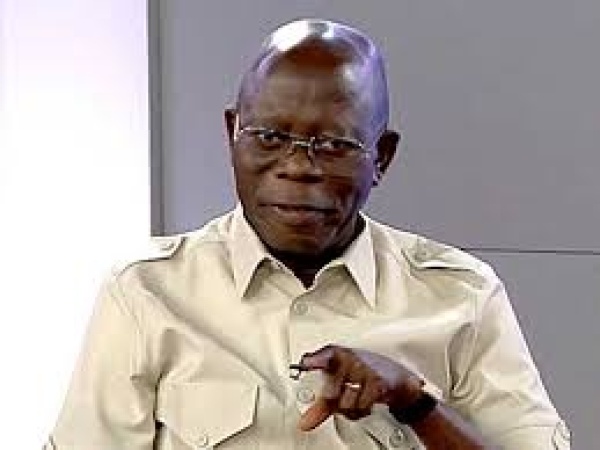
Former governor of Edo State and current senator representing Edo North District, Comrade Adams Oshiomhole, discusses constituency projects, the national budget, debt servicing, and ongoing economic reforms, emphasising why Nigeria must prioritise productivity over religious sentiment. He also bares his mind on the rationale behind his constituency empowerment initiatives, Governor Monday Okpebholo’s first year in office, the state of governance after the Obaseki years, and the evolving political dynamics within the All Progressives Congress (APC) in Edo State. Edo State Correspondent, IDOHOSA MOSES, brings excerpts of the interview.
There have been questions about constituency projects and how they are funded. Can you clarify your role?
A constituency project is a government-funded project. The money does not come to my pocket. It is paid directly to the appropriate federal agency. My role is simply to recommend projects worth up to my constituency allocation. In the last cycle, the allocation was about ₦2 billion. When you divide that by the six local governments in Edo North, each gets roughly ₦333 million.
I only determine what project goes where. I do not award contracts, and I do not receive or release the funds. The Federal Government awards the contracts and pays the contractors directly. That is the only process I know. Now, if some people decide to commit fraud, fake paperwork, collusion between contractors and agencies, or claim a job was completed when nothing was done, that is stealing. It has nothing to do with constituency projects. Fraud exists everywhere, in both public and private sectors.
Do you have the authority to supervise or monitor these projects?
Yes. The National Assembly has oversight power over anything involving public funds. Once money is allocated, we have the constitutional right to examine how it is used. That is why, in one of my motions, I urged the Senate Committee on Defence to scrutinise military spending, to ensure Nigerian taxpayers get value for money and our Armed Forces are adequately equipped to fight insecurity. Oversight is our duty.
What is the Federal government’s limitation when it comes to capital projects?
You cannot spend more than you have. If you follow our debates, you will know that we recently approved borrowing because the national budget is a deficit budget. You cannot execute a deficit budget until borrowed funds come in.
Before this administration came in, between 80 and 90 percent of Federal Government revenue was being used to service debt. Almost every naira collected was going into recurrent expenditure. We were not even earning enough to pay salaries. That was why some agencies and even states defaulted. Things have improved, but not enough to finance massive capital projects. Yet without capital projects, roads, power, housing, and hospitals—the economy cannot grow.
Some argue that the current government created the debt burden. What is your view?
That is incorrect. Most of the debts we are servicing today are not from this administration. They were taken over many years under Presidents Olusegun Obasanjo, Umaru Musa Yar’Adua, Goodluck Jonathan, and even Muhammadu Buhari. Loans have moratorium periods. Many of them are now due for payment.
Government is a continuum. Loans borrowed in Nigeria’s name must be repaid by Nigeria. After paying salaries and servicing old debts, little remains for infrastructure, health, and education. That is why borrowing continues, to keep the system running and still fund critical capital projects.
What is your assessment of the economic reforms, especially regarding the naira and forex policy?
The President is working to avoid excessive domestic borrowing and to ensure we do not borrow in ways that destabilise the exchange rate. That is partly why the naira has been gradually appreciating. It is a significant improvement.
Another challenge we face is policy instability. Once progress starts, some people try to cause confusion and push for reversal. Investors don’t like uncertainty. Policy must be sustained.
The previous dual exchange rate regime enriched a connected few. Some people got dollars cheaply from the CBN and sold them at double the price. Ordinary Nigerians suffered. President Tinubu has now ended that system.
This reform shut down a channel that made unproductive people instant billionaires while frustrating hardworking youths. It also ended the influence of the so-called “CBN cabal.” The President could have enriched himself before ending it—but he didn’t. As we say, what we forbid, we do not share with our teeth.
You mentioned subsidy fraud in the past. What did your committee find?
As a member of the Senate Public Accounts Committee, we discovered that the previous NNPC management was paying subsidies from crude proceeds using inflated and unverifiable figures. They claimed outrageous daily fuel consumption numbers and blamed smuggling to justify billions of dollars in losses. In truth, billions were stolen. Since the subsidy removal, more money is now available to all tiers of government. States should be paying better wages because their allocations have increased.
How does this affect the local economy?
Salary earners spend their money locally—food, rent, transportation, school supplies—things produced by ordinary Nigerians. That is how money circulates and stimulates the domestic economy. The wealthy often spend on imported luxuries that pressure the exchange rate.
Look at Edo State. The projects Governor Monday Okpebholo is executing, who is doing the work? Labourers, artisans, engineers, suppliers. The money paid to contractors circulates within Edo State. That is how an economy grows.
You often speak about productivity. What exactly do you mean?
Prosperity does not come from prayers; it comes from work. This is where I disagree with those who say you must do all-night prayers every day. If you pray all night and you are exhausted in the morning, you cannot work. Do all-night work, not all-night prayers.
That is my personal conviction. I am a Catholic. God did not create me to spend all my nights praying to Him. I should either be sleeping—so I can work the next day—or working so I can be productive. That is the mindset we need as a country.
What then, in your view, is your real mandate as a senator?
My core responsibility is legislative work, not competing with the executive on projects. We operate under three arms of government. The Executive, led by the President and ministers, implements policies. The Legislature, the Senate and House of Representatives, makes laws and appropriate funds. The Judiciary interprets the law.
So, my true work is in debates, motions, and laws. For example, I moved a motion recently on sexual harassment, not just in tertiary institutions but across society, including workplaces and even homes. Today, even young boys face harassment. It is a global issue. That motion wasn’t for Edo North alone; it was for Nigeria. That is the essence of being a senator: representing your district, but legislating for the entire country.
How would you describe your role as a senator compared to being a governor?
The role of a senator is completely different from that of a governor. A senator is a voice out of many in Abuja. Although I represent Edo North Senatorial District, we are first and foremost senators of the Federal Republic of Nigeria, and we deal with all sorts of issues.
When you get to the Senate, it is important that you introduce yourself in terms of where you come from, but your constituency is the Federal Republic of Nigeria. The laws we make are meant to have national application. The appropriations, the motions – whatever it is we do – are targeted at making the whole nation better. So, I prefer to play my part in that regard.
You will recall that during my campaign, I said the most important federal project for me was fixing the Benin–Auchi–Okene road. Growing up, it took about an hour and a half to get from Iyamho to Benin City. At some point, it took seven hours, and if you were unlucky, you would sleep on the road. And with the industrialisation of Okpella – now a cement hub – the pressure on the road increased.
My first motion in the Senate was on the Benin–Okpella–Okene Road. Together with Governor Monday Okpebholo, then as a senator, we put pressure on President Tinubu to think outside the box to fund the road. I even had a hot exchange with the Minister of Works when he budgeted only ₦200 million for that road in 2024.
As we speak, I believe the road is under construction. For me, that is the most important federal project for Edo.
How would you assess Governor Monday Okpebholo’s one year in office?
This is where I disagree with the Nigerian media. You are a resident here. Editors always say the role of the media is to inform with facts, not fiction; enlighten – to make people wiser; and, if there is space, to entertain. You live in Benin City. You attend programmes across the 18 Local Government Areas. So why are you quoting a dead party?
You had a meeting with the Peoples Democratic Party’s (PDP) ancestors. PDP is a political ancestor; they no longer live. When you are dead, you join the ancestors. So, is it from their graves they spoke to you? Because I can only answer questions from the living, not the dead. And I am not in a hurry to join them.
Don’t talk about PDP. Instead, ask: What did they do in their first year? They did countless groundbreakings – Gelegele Port that turned out to be in Benin whenever it rains, housing estates, and other things. They broke the ground so much that Edo almost became an earthquake zone! Thank God for our soil.
Governor Okpebholo inherited a state abandoned for eight years after I left. Yet in less than a year, he has shown visible results. Yesterday (November 12), he showed pictures of the most congested parts of Benin – Ramat Park, for example, and why he is decongesting the area by building a flyover, not by horsewhip.
Those going straight will pass on the flyover; those going to the markets can access them with ease. That has serious economic benefits. People spend hours in traffic, burning fuel and missing appointments. That’s value lost.
He presented clearly eye-marked projects – roads under construction – and showed photographs. If anyone disputes them, that’s their choice. But I know them to be facts.
You spoke about education during the previous administration. What is your assessment now?
I introduced the red-roof schools. Governor Godwin Obaseki claimed to be doing EdoBEST, but it was not true. He even misled the World Bank by showing pre-arranged schools that I built while claiming that from his office, he could tell whether a teacher was in class—even where there was no Wi-Fi or electricity.
The media failed to educate the public that such surveillance is impossible without Wi-Fi. Even Ossiomo light wasn’t connected to the schools. Yet he got away with those untruths because the media repeated them.
Before I left, I commissioned University of Benin (UNIBEN) professors to help recruit qualified teachers because I once encountered a Grade Level 12 teacher who could not spell “affidavit” or read “I solemnly declare.” We fixed that, but by the time Obaseki left, many schools had only two or three teachers. Even in Benin, many had no roofs. Governor Okpebholo is now rebuilding those schools. He showed pictures of children clapping in clean environments. These are facts.
What about the state-owned universities?
Ambrose Alli University (AAU) suffered terribly. When I was the governor, I was giving the university ₦252 million monthly as subvention. Governor Obaseki reduced it to ₦94 million, then to ₦41 million – only to take back the money through taxes. That is zero subvention. Hence the endless strikes.
A medical degree that takes six years was taking 12 years. Governor Okpebholo has solved that. He has increased AAU’s subvention to ₦500 million monthly – ₦6 billion a year. These are facts you can verify from the Vice-Chancellor.
For Edo University, Iyamho, my administration was giving the school ₦100 million monthly as subvention. Obaseki removed it completely. Governor Okpebholo has raised it to ₦250 million monthly. Again, facts.
You also mentioned issues with traditional institutions. Can you elaborate?
Obaseki created tension by trying to re-partition Benin Kingdom and elevate dukes, appointees into kings. That could have caused a serious crisis. Governance requires peace. Governor Okpebholo has resolved all that. You saw the Oba of Benin happily attending yesterday’s event.
Obaseki also deposed many traditional rulers for political reasons. He even installed someone illegally to deceive foreign investors in MOWAA. In Okpella, he planted his Senior Special Assistant (SSA) as traditional ruler without due process. Okpebholo has reversed all these and restored the law. There is now relief across Edo State.
What is your overall verdict on Governor Okpebholo’s first year?
The question is not whether he has taken Edo from zero to one hundred. No. But in one year, he has done a lot, and he showed the evidence yesterday. His humility is infectious, yet behind it is a strong mind. He hires, and if you misbehave, he fires. That sends a message: nothing is permanent. Perform and keep your job; fail and lose it.
Across Edo State, there is relief. I come home often; I am not an Abuja-based politician. Just two days ago, on my way to commission a road in Akoko-Edo, I saw major roads the governor has already rebuilt. We in the APC family are very happy with him. Action speaks louder than voice, and there is no better example than Governor Monday Okpebholo.
What should Nigerians expect from your Committee on Museum of West African Art (MOWAA)?
What we expect is straightforward: the committee will carry out its assignment strictly according to its terms of reference. Our job is to unearth and establish all the facts, whether it is MOWAA, EMOWAA, or whatever name they call it. All of that will be clarified.
Until the investigation is concluded, I won’t preempt the outcome. What I can assure you is that the governor has the political will to ensure that the right thing is done. And what is the right thing? Acting on the basis of facts. Once the committee exposes the facts, the next steps will be clear.
But you can’t ask me to describe the hole of a rabbit that has not been caught. When we finally catch the rabbit and depending on the nature of that rabbit, the governor will decide what to do with it.
Is all well within your party, the APC, in Edo State?
Do I look sick? We are in a democracy. When a party is big, it is like a family, and every family has different tendencies. The head of this political family in Edo is the governor. He is the leader of the APC in the state, and he is at peace with the members.
If some people say one thing and others say another, it simply shows that the system is open and democratic. People are free to express themselves; nobody will be gagged. Social media enjoys the drama and that’s fine.
Recently, you distributed grinding machines and others to your constituents. Recall that before your election into the Senate, you spoke against such items as empowerment tools. Why are you now doing what you once criticised?
You are asking the kind of question a journalist should ask, going down memory lane. Yes, I did say some things in the past. And what I said was clear: I would not buy motorcycles as empowerment because I don’t consider them empowerment, and I still stand by that. A young man starts riding a motorcycle at 18, and if he is lucky not to harm himself, by 30 or 35 he may not be able to continue. At that point he has no skill, only the illusion of daily returns.
But I never said sewing machines or grinding machines are inherently wrong. What I said was that these tokens should not be the essence of being a senator. I don’t need to be a senator to give someone a sewing machine if I can afford it personally. So, in evaluating me as a senator, don’t judge me by the tokens; judge me by my legislative work.
So, why did you distribute these items across the wards?
Because some people genuinely need them. I have helped young women learning fashion design to buy industrial machines. In fact, there was a lady who needed an industrial machine; she wasn’t even on my list, but I sent her money to buy one. Across the 62 wards of Edo North, we ensured that each received support—at least one or two grinding machines, industrial sewing machines, or refrigerators. You might live in a big city, but in smaller communities, a refrigerator is empowerment. Someone can buy a few crates of soft drinks, keep them chilled, and make a steady income.
I remember a woman who kept disturbing me for empowerment. I told her I didn’t have money, but eventually I gave her ₦50,000, more than she expected, just so she could buy a few crates of drinks and start something. That is real empowerment.
I also bought a few Keke NAPEP (tricycles). In many communities, they are economically viable. There is nothing shameful about it. Even in Abuja and Benin, people earn a living from tricycles, often better than some young graduates, if they manage well. So yes, these are forms of empowerment I believe in. But they are not my core mandate. (TRIBUNE)