Updating your news feed...

NEWS EXPRESS is Nigeria’s leading online newspaper. Published by Africa’s international award-winning journalist, Mr. Isaac Umunna, NEWS EXPRESS is Nigeria’s first truly professional online daily newspaper. It is published from Lagos, Nigeria’s economic and media hub, and has a provision for occasional special print editions. Thanks to our vast network of sources and dedicated team of professional journalists and contributors spread across Nigeria and overseas, NEWS EXPRESS has become synonymous with newsbreaks and exclusive stories from around the world.





















Loading banners
Loading banners...

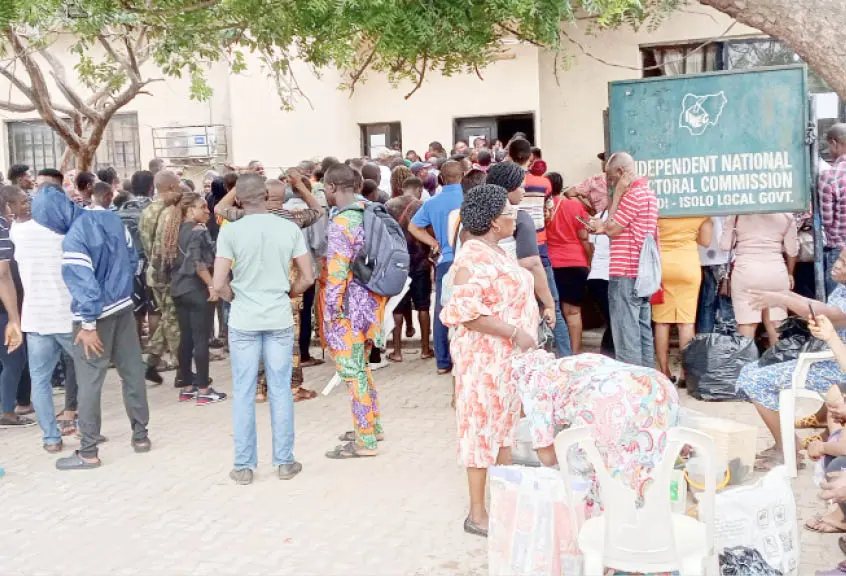
The Independent National Electoral Commission (INEC) on Wednesday explained why only about 2.57 million Nigerians have completed their voter registration out of the 9.89 million who began the process online in the first phase of the ongoing Continuous Voter Registration (CVR) exercise.
INEC’s Director of Voter Education and Publicity, Mrs Victoria Eta-Messi, who provided the latest update, said 9,891,801 Nigerians initiated pre-registration online, but only 2,572,054 completed the process physically or online.
According to the breakdown, Osun State tops the national chart with 200,251 newly registered voters, followed by Kano with 151,604, Imo with 144,912, and Sokoto with 141,526. States with the lowest completed registrations include Ekiti (14,691), Abia (15,263), Ondo (17,200), Enugu (18,056) and Ebonyi (26,510).
She said the first phase of the exercise which began with online pre-registration on August 18 and in-person registration on August 25 will close on December 10.
Eta-Messi added that the commission will display the preliminary voters’ register for claims and objections from December 15 to 21, in line with Section 19 of the Electoral Act 2022. The second phase of the CVR will begin on January 15, 2026.
“The display will take place at the local government offices where the exercise was conducted. The Commission urges all eligible citizens, especially those who registered, transferred or updated their information during this phase, to use this statutory window to verify their details, report inaccuracies and draw attention to ineligible or deceased persons,” she said.
She stressed that public scrutiny remains essential to safeguarding the integrity of the register.
She also reminded Nigerians that the CVR in Anambra State and the Federal Capital Territory remains suspended due to ongoing electoral activities, with new dates to be announced.
INEC gives reasons for large gap in figures
Meanwhile, INEC officials and election observers offered explanations for the large gap between online pre-registrations and completed registrations, noting that the discrepancy is neither unusual nor unexpected.
When contacted, the Deputy Director of Publicity at INEC, Wilfred Osilama Ifogah, said many Nigerians begin their registration online but are unable to complete the mandatory physical capture due to factors largely outside the Commission’s control.
He said work-related constraints remain one of the biggest obstacles. “It’s possible the time to complete it is not favourable to them because of their work schedule,” he noted.
He also revealed that some applicants who began the process abroad were unable to complete it upon returning to Nigeria. “It’s possible some of these individuals initiated the process outside the country believing they will complete it when they arrive.”
Another reason for the drop-off, he said, is that some people who start the process are found ineligible during physical verification. “Some who initiated it may have been previously registered or do not qualify. At the point of physical capturing, further investigation is done.”
Despite the challenges, Ifogah expressed optimism that more applicants will complete their registration when the exercise resumes in January. “This is just the end of the first phase. It is hoped that when we resume, most of those yet to complete theirs will do so.”
Observers cite multiple registrations, logistical hurdles
On his part, Samson Itodo, the Executive Director of Yiaga Africa, a leading election-monitoring organisation, said the discrepancy between the online and completed figures mirrors patterns seen in previous CVR exercises, pointing to multiple registrations, logistical barriers and declining public motivation as major factors.
He said some of the 9.8 million online entries may be fraudulent or incomplete. “We have always contended that those people could be as a result of double and multiple registration, but also an attempt by political actors to pad the voter register,” he said.
According to him, the “real” registration only happens after biometric capture. “Where are all those people? Why are they not showing up? Some of those records are not credible.”
Itodo also highlighted geographical and logistical challenges that prevented many Nigerians from completing their registration. In many LGAs, he said, registration centres are few and far between, while queues are long and poorly managed.
“There have been complaints about logistical challenges,” he said. “For most people, they are unable to participate in biometric capture either because of the location of the centres—which are mostly in LGA offices—or issues related to queue and crowd management.”
He said insufficient mobilisation and declining civic enthusiasm have also contributed to the low completion rate. “At the start of the process, there was huge mobilisation. But publicity and mobilisation seemed to have reduced in the last couple of months.”
According to him, political developments in recent months have dampened citizens’ confidence in the electoral process. “Some of this lethargy is driven by developments in the polity, which are affecting voters’ confidence.”
He added that the discrepancies are “an assortment of factors,” not a single cause.
Calls for stronger safeguards
Itodo urged INEC to step up its verification and clean-up processes to ensure the integrity of the 2027 voter register. “The burden now lies on INEC to upgrade its clean-up process,” he said.
“Those nine million online registrations—we need to know exactly whether those are actual individuals, actual human beings. These are vulnerabilities that could be exploited to pad the register.”
He cautioned that previous experiences, where inflated or fictitious entries slipped through the system, should not be repeated in 2027. “We have to ensure vigilance because these are vulnerabilities,” he said.
egistration on August 18 and in-person registration on August 25 will close on December 10. (DAILY TRUST)