ADAD
ADADUpdating your news feed...

NEWS EXPRESS is Nigeria’s leading online newspaper. Published by Africa’s international award-winning journalist, Mr. Isaac Umunna, NEWS EXPRESS is Nigeria’s first truly professional online daily newspaper. It is published from Lagos, Nigeria’s economic and media hub, and has a provision for occasional special print editions. Thanks to our vast network of sources and dedicated team of professional journalists and contributors spread across Nigeria and overseas, NEWS EXPRESS has become synonymous with newsbreaks and exclusive stories from around the world.








.webp)


Loading banners
Loading banners...


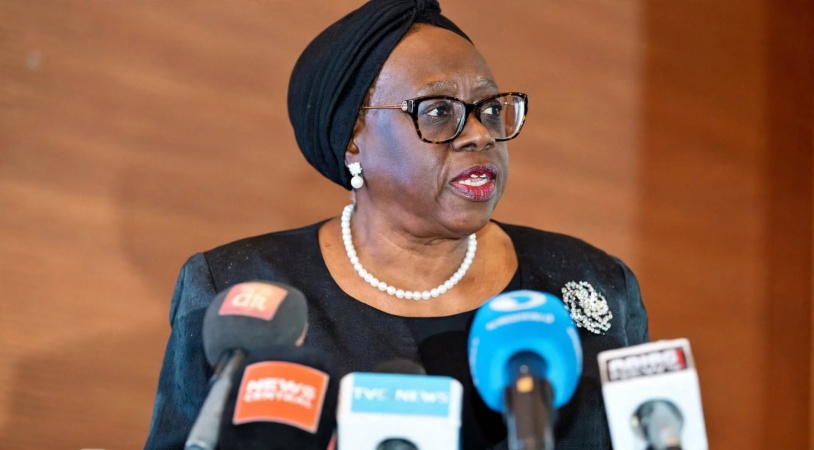
CVCNUs Chairman, Prof Lilian Salami
The Human Rights Writers Association of Nigeria (HURIWA) has called on the federal government to prioritise education of all children in the country, especially those from poor families.
The call whichh is contained in a statement by the National Coordinator of HURIWA, Comrade Emmanuel Onwubiko, was sequel to the decision by the Committee of Vice-Chancellors of Nigerian Universities (CVCNUs) to increase its obligatory and some other fees being charged to students.
The group disagreed with the recent CVCNUs’ pronouncements regarding the necessity for fee hikes in federal universities, contending that the logic behind such decisions was not plausible.
“The recent pronouncements by CVCNUs regarding fee hikes in Nigerian federal universities are at odds with the legal and moral obligations of the government to fund education. HURIWA contends that it is the responsibility of the government to ensure that public universities are adequately funded to maintain affordable tuition fees,” the statement reads in part.
It strongly argued for the government’s responsibility in funding education and exploring of alternative funding mechanisms for public universities to reduce the financial burden on students, especially those from economically-disadvantaged backgrounds.
HURIWA maintained that every child has the right to education in Nigeria.
“The right to education is an essential human right enshrined in both the Nigerian Constitution and international human rights instruments that Nigeria is a party to. Article 18 (chapter II) of Nigeria’s Constitution 1999 states that the government’s policy shall be directed towards ensuring there are equal and adequate educational opportunities at all levels. Moreover, it mandates that education shall be free and compulsory for all children of school age. “While this chapter is non-justiciable under section 6 (6) of the Constitution, a 2017 landmark judgment by the Federal High Court in Abuja declared that the right to compulsory, free, and universal primary and junior secondary education is enforceable in Nigeria.
“This decision is based on the Compulsory, Free Universal Basic Education Act, 2004, enacted by the National Assembly, which makes specific provisions for basic education,” the group noted.
On funding education, HURIWA held that constitutional provisions and international commitments highlight the government’s primary responsibility for funding and ensuring access to quality education, especially in public institutions.
“Therefore, the argument put forth by CVCNUs that fee hikes are unavoidable due to the financial strain on universities is flawed. Instead, it is the government’s duty to provide sufficient financial support to these institutions,” it argued
The group further gave several reasons why government should not shift the responsibility of funding education to students which include that: “the Constitution and international human rights treaties obligate the government to direct its policies towards providing equal and adequate educational opportunities, making education free and compulsory, adding that these legal commitments emphasize that the government should bear the bulk of the financial burden in the education sector.
“Education is not just a privilege but an economic and social right. It is essential for the full development of human personality and the strengthening of respect for human rights and fundamental freedoms. Increasing fees can limit access to education and hinder the full development of the human personality, contravening international standards.
“Fee hikes exacerbate inequality in access to education. They disproportionately affect students from low-income backgrounds, potentially excluding them from higher education opportunities. This goes against the principle of non-discrimination in education, as outlined in international human rights instruments like the International Covenant on Economic, Social and Cultural Rights (ICESCR).”
HURIWA, therefore, argued that rather than placing the financial burden on students, public universities should explore alternative funding mechanisms to supplement government subventions. It suggested that such mechanisms could include:
“Public universities engaging in collaborative research projects with corporate bodies and manufacturing companies, a partnerships that could yield research funding and promote innovation, generating revenue for the universities;
“Establishing endowments and seeking support from alumni can provide sustainable sources of funding. Encouraging alumni to give back to their alma mater can significantly contribute to the financial stability of universities; prioritizing transparent and efficient financial management to make good use of available resources by being prudent in budgeting, adopting cost-saving measures and reducing wastage.”
It added that the government should fulfill its obligation of adequately funding public universities and ensure that they could maintain affordable tuition fees for all students, regardless of their economic backgrounds.
In its further recommendations, the group said that there should be monitoring and documentation of cases of human rights violations related to education, especially those resulting from fee hikes; promote the justiciability of the right to education in Nigeria, allowing individuals and organizations to take legal action against the government for failing to provide quality and affordable education; and collaborating with stakeholders, including students, parents, universities, and government agencies, to find sustainable solutions to the financial challenges facing universities.”
HURIWA is a non-governmental organization committed to the promotion and protection of human rights in Nigeria, including safeguarding the right to education.