Updating your news feed...
NEWS EXPRESS is Nigeria’s leading online newspaper. Published by Africa’s international award-winning journalist, Mr. Isaac Umunna, NEWS EXPRESS is Nigeria’s first truly professional online daily newspaper. It is published from Lagos, Nigeria’s economic and media hub, and has a provision for occasional special print editions. Thanks to our vast network of sources and dedicated team of professional journalists and contributors spread across Nigeria and overseas, NEWS EXPRESS has become synonymous with newsbreaks and exclusive stories from around the world.










Loading banners
Loading banners...


Nigerian soldiers fighting Boko Haram insurgency in the North-East have devised unusual methods to cope with Post Traumatic Stress Disorder in the absence of quality healthcare.
Puffing on a stick of cigarette while standing underneath a pear tree, 28-year-old Olanrewajuwas lost in a Fuji music blasting from his audio device. He stomped his left foot to the rhythm, swaying from side to side. Close to him was a rifle with a red piece of cloth tied around its shaft.
“I love Ayinde Barrister’s songs a lot. It makes me forget bad memories,” he said casually as some boys who came to the neighbourhood in Ikorodu, Lagos, to buy food from a vendor hailed him.
Olanrewaju had just clocked 28 a few days ago and was preparing to go back to Maiduguri, Borno State, to ‘replace some fallen heroes’ at the war front, fighting Boko Haram insurgency which has ravaged the region for years.
“I am enjoying my life now because anything can happen,” he said as he tore open a sachet of gin and downed it in one gulp. “I had been at the war front before. I have seen things. The first man I killed, to date, I still see him in my dream,” he said, turning down the volume of the music to foreground his message.
“It was an order,” he noted crisply. “‘Shoot!’ And I shot him. It was in 2017. I was in Maiduguri. The first bullet hit the man on his nape and tore his head open. I watched as he fell to his knees, and then, face down. My oga (commander) said the man was an enemy of the state and did not deserve any mercy!” Olanrewaju further said, stepping on his half-smoked cigar.
He went on, “Whenever I sleep, I see that man. I see blood gushing out of his head. That memory never leaves me; the picture is fresh in my mind. Forget this gun I am holding; I am not a happy man. I am going through hell. Sometimes, I feel like blowing my head off so I can just have peace.”
When Olanrewaju received his first letter stating that he had been deployed in Borno to join in the fight against Boko Haram, he said it was “as though it were the end of the world.”
He had just joined the army a few years before and thought it would take a while before he would be posted to the battlefield.
He was wrong. He was shocked when he received a posting letter to one of the military bases in the northeastern state.
“My mother was crying, begging me not to go. I was confused about what to do. I eventually told her I must go,” he said.
Olanrewaju said he got an awkward welcome when he and over 100 other young soldiers arrived at the military base.
According to him, some soldiers’ uniforms were covered with bloodstains. Some female soldiers were nursing a male soldier’s leg.
He noted, “Seeing that alone traumatised me even more. As I speak to you now, I can picture that scene in my head. That night, we heard stories of people who had died the previous week. Two senior officers had been brutally injured and died before they were carried to the base. The stories not only scared me but made me almost livid for a while. I think the other boys also felt that way but pretended to be fine.”
It dawned on Olanrewaju he was in for serious business after his first operation during which one of his colleagues lost his life.
He said, “I heard he was the only surviving son of his father. I saw his corpse. The bullet pierced through his skull. It was a gory sight; it made me so scared. No one spoke about what we had seen. Everybody was acting as if it was normal. I was losing my mind. The next day, we were back at the battlefield. No retreat, no surrender!”
Olanrewaju’s voice had gone significantly low. His phone rang. It was another officer, Tunji, who promised to meet us at the joint soon.
Tunji came in with a bright smile that lightened up the atmosphere. He exchanged pleasantries with Olanrewaju before he began to share his many close shaves with death with our correspondent.
“I am not afraid of death. That is one thing that keeps me going. I know that I can die any time. One time, on the battlefield, one of my close friends was gunned down in my presence and we had to advance further to attack the enemy. To date, I feel guilty,” he stated, showing our correspondent some marks on his hands. “I cut myself most times before I can sleep.”
Tunji paused for a moment and gestured to Olarenwaju who helped him light up a cigarette. “I have wanted to kill myself several times,” he revealed as he puffed smoke in the air through his mouth and nostrils, staring at our correspondent.
Asked if they had sought help to cope with the trauma caused by their operations on the battlefield, Olarenwaju said, “Which one is trauma? Is it what you want to tell your superiors? When they say, ‘shoot!’, you shoot!”
In his response, Tunji said, “It was so bad one time that I would be aloof for almost four hours. I wouldn’t hear or see anyone or anything. I would be hallucinating. I confided in a friend who told me to report to the hospital for some mental check, but I am a man. We are expected to be strong as soldiers.”
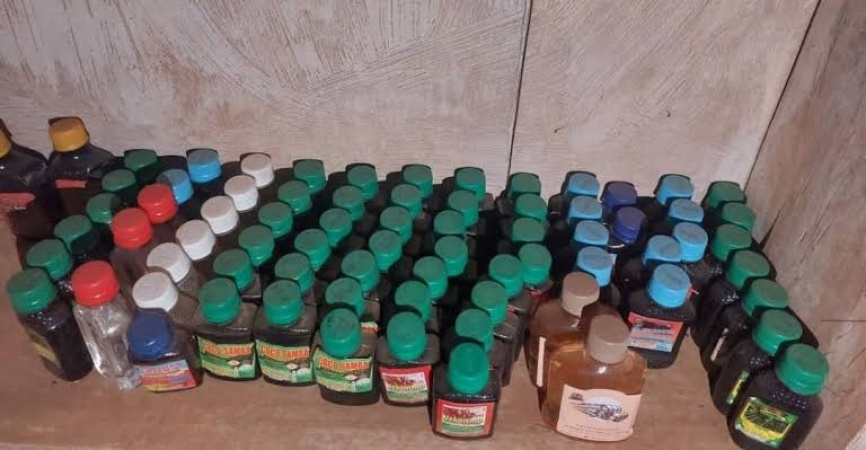
Before the end of the encounter with Olanrewaju and Tunji which lasted for about four hours, they had both exhausted over 10 sticks of cigarette, 11 sachets of gin and two small bottles of a bitter drink.
The American Psychiatric Association defines PTSD as a psychiatric disorder that may occur in people who have experienced or witnessed a traumatic event such as a natural disaster, serious accident,terrorist act, war, rape or who have been threatened with death, sexual violence or serious injury.
PTSD has been known by many names in the past such as “shell shock” during the years of World War I and “combat fatigue” after World War II, but it does not just happen to combat veterans. PTSD can occur in all people at any age. It affects approximately 3.5 per cent of the United States adults every year, and an estimated one in 11 people will be diagnosed with PTSD in their lifetime.
People with PTSD have intense, disturbing thoughts and feelings related to their experience that last long after the traumatic event has ended. They may relive the event through flashbacks or nightmares; they may feel sadness, fear or anger; and they may feel detached or estranged from other people.
They may also avoid situations or people that remind them of the traumatic event, and they may have strong negative reactions to something as ordinary as a loud noise or an accidental touch.
Shedding more light on the condition, a professor of Clinical Psychology, School of Medicine, University of Benin, Edo State, Caroline Ofovwe, said, “PTSD is a mental health issue that affects the everyday lives of people who have experienced traumatic events like natural disasters, car accidents, abuse, being in the war front and all other forms of trauma.
“PTSD could be suffered by anybody who has experienced a form of trauma. Trauma is subjective. This means that what an individual sees as highly traumatic may not be so for another individual.
“For PTSD, it is an objective issue in that it has symptoms accompanying it and if those symptoms persist, they create dysfunctionality such that the individual may no longer go about their social life or occupational life the way they used to,” she said.
According to a recent research by Deborah Onyine, Roland Okoro and Adamu Zimboh, titled, ‘The Prevalence of depression and post-traumatic stress disorder among internally displaced persons in Maiduguri, Nigeria,’ the occurrence of PTSD in Nigeria ranges from 40 to 42 per cent.
The paper also highlights the high prevalence of depression and PTSD among Nigerians and calls for structural interventions to deal with mental health problems.
In another research by Olutoyin Sekoni published in August 2021, it was found that PTSD could be associated with mental disorders such as depression and anxiety. It was also stated that PTSD experienced together with other mental disorders, or on its own might contribute to a significant reduction in quality of life.
Research examining the prevalence and risk factors associated with PTSD suggests that it is associated with a range of socio-demographic characteristics.
In Nigeria, where there have been a wide range of traumatic experiences, the prevalence of PTSD is said to range widely between 2.7 and 66.7 per cent.
Experts identify pointers of PTSD in Nigeria to include political and ethnoreligious violence and road traffic accidents. Its manifestation in soldiers like Olanrewaju and Tunji, who are at the centre of violence, is better imagined.
A serving soldier, who gave his name simply as Somtochukwu, told our correspondent that he consumed between six and nine bottles of alcohol whenever he was off duty.
“I just have to drink. I need to forget some of these things in my head. They are too much,” he said.
Though Somtochukwu refused to give details of what his first operation was, he explained that he once mistakenly killed a woman whom he mistook for an insurgent.
He said, “All I heard was ‘Wayo!’ and she fell to the ground. My colleagues moved on as though nothing had happened. I was telling them that I had killed someone and they said, ‘collateral damage’ and moved on. I stood there for a while and looked at her. Her eyes were opened and it was like she was looking at me. I left the north in 2018, but the memory always flashes in my head.”
The 37-year-old soldier said he also suffered from constant headaches because he felt guilty of killing the woman.
He said, “Most times you see me, I am talking to myself. My head is pounding. My mind is blaming me. Until I shout and take a bottle of beer, it does not stop.”
A female soldier, simply identified as Chika, explained that though she didn’t go to the war front, her stay at a military base in the northeast made her restless at night.
She said, “I don’t sleep well. I have watched many people die right before me. One of my friends kept telling me to take care of his son and wife as he died. I cried all through that night as they took him out. The next day, everyone dressed up and went about their normal duties.
“There was a day one of the junior officers took a drug overdose and died. A very young man in his 30s just died like that. Only God knows the demons he was fighting. We are dying, not just from Boko Haram and ISWAP (Islamic State West Africa Province) attacks, but from our own experiences,” she added.
The Nigerian Army on February 26, 2020 announced that a corporal at the theatre command in the North-East went ‘berserk’, murdered four of his colleagues, injured two others and killed himself.
In 2018, there were numerous reports of soldiers who allegedly committed suicide. In Borno, it was reported that a soldier committed suicide after killing a colleague. That same year, another report showed that a soldier opened fire at a military facility in Abuja, killing one colleague and injuring another before fatally ripping apart his own mouth with the rifle.
In November 2020, a soldier in the North-East reportedly opened fire on a captain, killing him before turning the gun on himself. Five months earlier, in June 2020, an army captain involved in Boko Haram war committed suicide while undergoing a psychiatric evaluation in Borno State.
Another report stated that a Nigerian Army captain who led an emergency response team was gunned down in Adamawa State by a fellow soldier who subsequently took his own life. The incident occurred at the 7 Division Medical Centre in Maiduguri on June 18, 2020, military sources had said.
The killer soldier was said to have been drafted to the North-East from the Nigerian Army 22 Armoured Brigade in Ilorin, Kwara State, to fight Boko Haram.
Although the army authorities did not give explanations on the circumstances surrounding these tragic incidents, they all had traces of mental disorders.
Interestingly, findings of a recent research by Brig.Gen. Gbenga Okulate (retd.), which used army officers as participants, indicates that six critical factors contribute to “murders and murder-suicide.” These are length of deployment, traumatic experiences, poor physical and mental welfare of troops, concerns about the welfare of family members, poor rehabilitation services, and personal tragedies. Sadly, these issues are rarely addressed because of poor psychosocial support.
Some soldiers have been on the battleground for four years, thereby increasing the chances of being predisposed to mental collapse.
Corroborating suicides among troops fighting Boko Haram insurgents, multiple sources told our correspondent that the rate had increased significantly over the years.
One said, “I can tell you that in my base, we have had about three cases between March and November 2021. We are even lucky because, in another base, they have had up to nine. We need help. I have seen things that keep me awake all night. I have held on for so long but don’t know for how long I may be able to. It gets worse by the day.”
Another source said, “I may not be able to give you a number, but just know that most of us here are losing our minds. I am scared that when I finally retire, I may not be able to relate well with my family. All I know is death.”
In his research, Okulate stated that, “these experiences traumatised survivors,” adding that the military had sustained many casualties.
For example, Reuters reported that between June 2018 and September 2019, security professionals estimated military casualties “at anywhere from hundreds of soldiers to in excess of 1,000. The military has not released casualty figures but denies that many soldiers have been killed.”
Okulate noted, “The soldiers feel betrayed and abandoned by their country. Personal tragedies, such as deaths of relatives and the breakdown of their marriages exacerbated these issues. The spouses of two of the participants died while they were at the war front. Others narrated how some spouses had moved on.
“One female soldier had told Okulate, ‘Some homes have been scattered…What has become of their wives? Other men have taken over their wives. A period of two years, four years and coming back their wives are pregnant for other men’. Soldiers vary in their ability to handle the mix of structural, organisational, and personal issues. Some have chosen murder-suicide as a way out or avenue to vent their frustrations,” he said.
In a post-traumatic seminar organised in November 2021 by the Army Headquarters Department of Transformation and Innovation, the Nigerian Army expressed concerns over PTSD among its personnel.
The army’s Chief of Transformation and Innovation, Maj. Gen. Charles Ofoche, said there was a need for awareness of the ailment, which he admitted was on the rise.
According to him, the awareness will help to contain the stress syndrome in order to achieve reduced operational risks, increased efficiency, and improved operational effectiveness.
He said, “The purpose of the seminar is to create awareness on the increasing incidences of Acute Stress Reaction, Acute Stress Disorder and Post-Traumatic Stress Disorder amongst the troops and its effects on military operations.
“The Nigerian Army intends to draw awareness of commanders to the stress syndrome to achieve reduced operational risks, increased efficiency, and improved operational effectiveness.”
The Chief of Army Staff, Lt. Gen. Faruk Yahaya, who was represented at the seminar by the Chief of Operations (Army), Maj. Gen. Olufemi Akinjobi, also acknowledged “accumulated stress as well as other mental disorders” was one of the implications of troops’ involvement in war against insurgency.
He added, “It is envisaged that drawing the awareness of disorder at the strategic level will help in the formulation of the right strategy for the management of affected troops’ welfare and administration.”
A consultant psychiatrist at the Yaba Psychiatric Hospital, Lagos, Dr Funmi Akinola, urged the soldiers with symptoms of PTSD to seek help, stating that it might pose serious threats to them and the nation at large if left untreated.
She said, “They have to talk to a therapist. There are no two ways about it. The army needs to provide psychological assistance to them so that when they come home, they’d find some form of solace. I consult for the Nigerian Navy and it was one of the very issues why I was hired – to deal with PTSD.
“These soldiers need somebody to talk to. They must be able to say all the things that are on their minds. If they cannot sleep, they need help so they can sleep. This is born out of an overwhelming anxiety.
“Ifnothing is done when they come back (from the war front), they may start having issues with their wives and families. That is why sometimes they end up drinking and abusing substances just so they can forget. But, once the effect of these drugs is gone, the issue is still there. That is where counseling comes in. They need to see a psychologist or a psychiatrist to help them cope,” she explained.
Akinola also urged the army to equip its health facilities with personnel who could help the troops fight the condition.
Decrying the state of some facilities, she said, “In some of these facilities, the proper things have not been done. Some of them would not want to talk to someone who they already know. They may need to talk to an outsider. It is likely they will open up more to someone they don’t know than to a officer in their own facility.
“It is not all of these facilities that have the right personnel. Some of them do not have social workers. How can you say you want to treat psychiatric issues without a social worker? Is it the doctor that will be chasing the patients around? When they are posted outside the base where they are diagnosed, most times, their superiors may not allow them to go to the clinic to continue the therapy sessions. That is where the social worker comes in. The social worker would follow up on the patient and be sure they are taking their drugs.”
<p style="color: #1d2228; font-family: 'Helvetica Neue', Helvetica, Arial, sans-serif; font-size: 13px; font-style: normal; font-variant-l